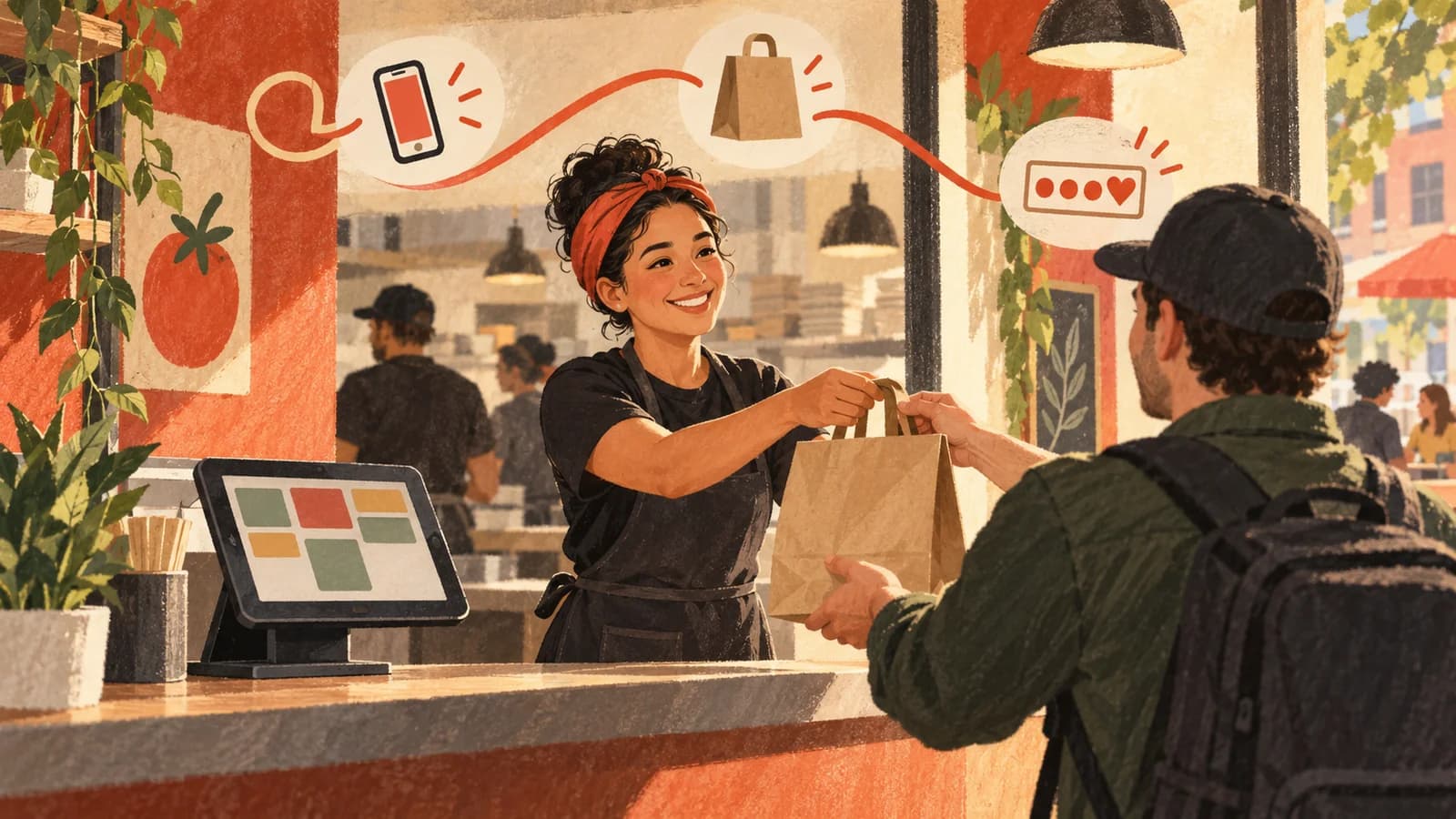
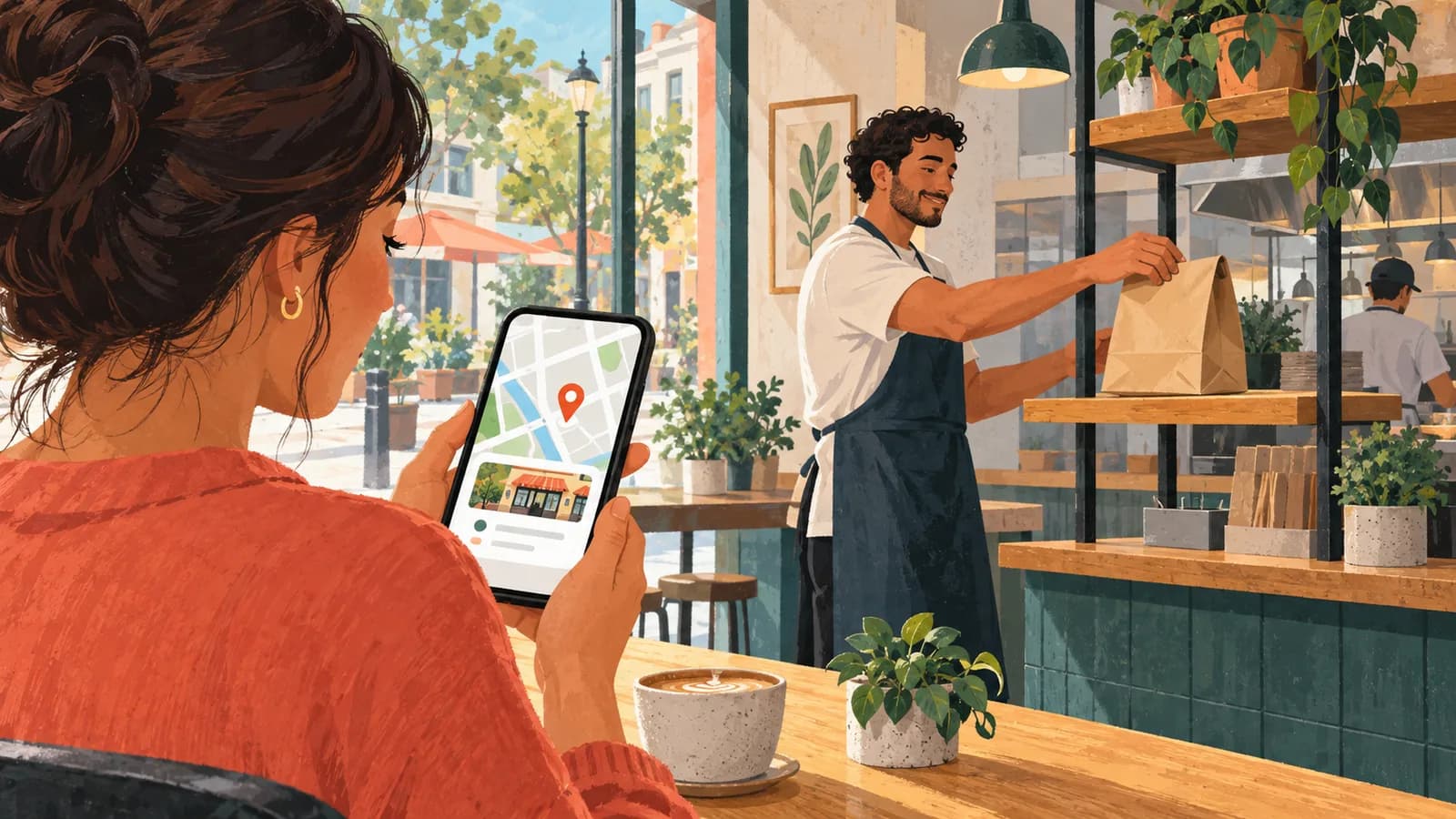
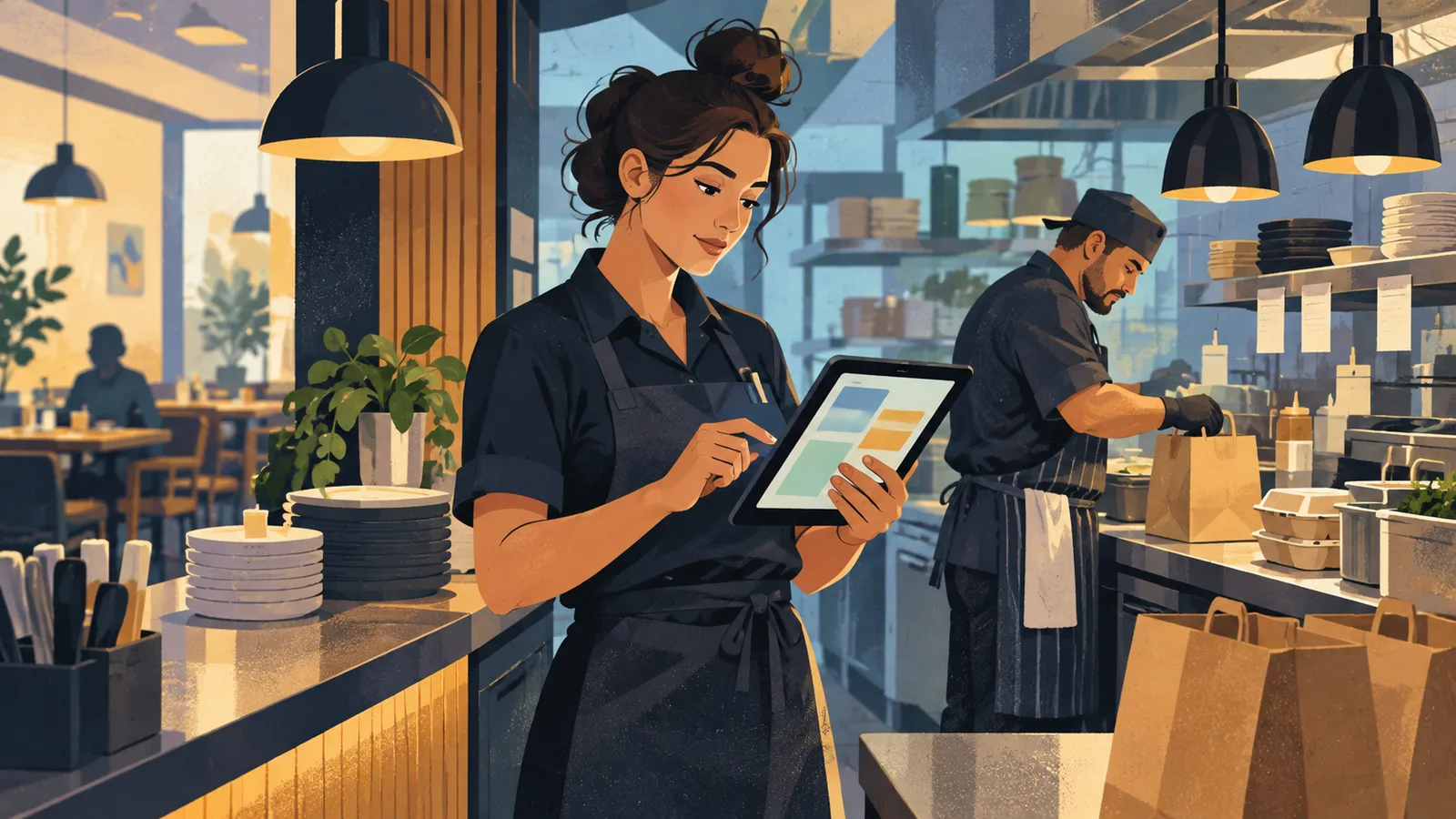
The tipping point arrived without a ceremony. Sometime in the last two years, digital ordering stopped being a growth feature for QSR chains and became the default mode of doing business. According to Mordor Intelligence's 2026 market data, more than 40% of chain restaurant transactions globally now originate through apps and websites. At several major brands, that share runs significantly higher.
This is not a story about apps as a novelty. It is a story about a structural shift in how restaurants make money, how they build physical space, and how they deploy labor. The implications reach from the drive-thru lane to the kitchen layout to the quarterly earnings call.
The Leaders Are Pulling Away from the Pack#
When industry averages sit at 40%, the outliers at the top reveal what the entire sector is moving toward.
Wingstop posted 73.2% digital sales penetration across its domestic location base, making it one of the highest digital-mix chains in the country. The company designed its entire operating model around this number: small footprints, minimal front-counter presence, kitchen configurations built for throughput rather than table service. Wingstop does not fight the shift; its unit economics depend on it.
Domino's has been above 80% digital for years across U.S. orders, a position it reached by building its own technology stack rather than relying on third-party platforms. The company's insistence on proprietary ordering channels gives it data ownership that platforms like DoorDash and Uber Eats will never share with franchisees.
McDonald's occupies a different position on the spectrum but operates at a scale that makes its numbers consequential in absolute terms. The company's digital loyalty program has accumulated 250 million members globally. McDonald's has not disclosed a single global digital mix figure, but on earnings calls the company consistently references digital channels as the primary driver of frequency and check-size improvement among its highest-value customers. The loyalty architecture pulls customers away from the counter, away from third-party apps, and toward the McDonald's owned ecosystem.
Starbucks sits in a structurally different category as a premium specialty beverage brand, but its mobile order-and-pay channel now represents roughly 30% of all U.S. company-operated transactions. The complication for Starbucks is that its mobile channel helped create the pickup congestion that drove in-store customer dissatisfaction, contributing to the traffic decline that preceded Brian Niccol's arrival as CEO. Even for a company that built one of the most sophisticated digital ordering systems in food service, execution at scale turned out to be harder than the technology itself.
Off-Premise Is the Business Now#
Digital ordering does not exist in isolation. It accelerated a parallel shift in where people consume the food they order: away from the dining room and toward the car, the office, and the home.
Off-premise formats, including drive-thru, delivery, and carryout, now account for more than 70% of revenue at leading QSR brands, according to Mordor Intelligence. That figure was already high before 2020. The pandemic pulled it higher. And the post-pandemic period has not reversed it in any meaningful way.
This has practical consequences for site selection, building design, and capital allocation. Operators are signing fewer leases on traditional end-cap restaurant spaces and more on smaller, drive-thru-forward pads. The new generation of restaurant prototypes reflects this directly. McDonald's is testing a fully digital, nearly dine-in-free format called CosMc's (now pivoting toward its McCafe concept). Taco Bell's Go Mobile format strips the dining room down to nearly nothing in favor of dual drive-thru lanes and mobile pickup cubbies. Chipotle's Digital Kitchen concept, deployed in high-density urban locations, does not offer traditional counter service at all.
These are not experimental side projects. They are proof-of-concept templates for where franchise construction capital flows next.
The First-Party vs. Third-Party Economics Problem#
The 40% digital share headline obscures a critical internal distinction that operators need to understand clearly: not all digital transactions are equally profitable.
Third-party delivery platforms typically charge commissions ranging from 15% to 30% per order. On a $14 average check, that represents $2.10 to $4.20 flowing directly to the marketplace before the restaurant covers food cost, labor, or occupancy. At typical QSR food margins, a 25% commission on a delivery order can turn a profitable transaction into a break-even or negative one.
First-party channels, whether a branded app, web ordering, or a loyalty program, bypass that commission entirely. The economic gap between a McDonald's app order and a DoorDash order, at identical menu prices, can be the difference between a contribution-positive and contribution-negative transaction.
This is why the major chains have invested so heavily in loyalty infrastructure. McDonald's 250 million member base is not a marketing vanity metric. It is a customer base that the company can retain and transact with at full margin. Every order shifted from a third-party platform to the McDonald's app is a margin recovery event.
Wingstop made this calculus explicit in investor communications. The company's stated goal has been to drive as much volume as possible through first-party digital channels to protect per-unit economics. Its 73% digital penetration is nearly entirely first-party.
Smaller chains and independent operators face a harder version of this problem. They lack the brand gravity to pull customers to a proprietary app. Their digital volume tends to flow through third-party platforms almost by default, which means their growing digital share often comes with compressing unit-level margins.
Physical Redesign: The Space No One Needs Anymore#
When digital and off-premise formats dominate transaction volume, the traditional restaurant floor plan becomes a liability.
Dining room square footage costs rent, requires cleaning, and needs maintenance. In a restaurant that generates 70% or more of revenue through drive-thru, pickup, and delivery, that dining room is subsidizing transactions that never use it.
The redesign happening across the industry reflects this math. Dining rooms are getting smaller. Kitchens and prep areas are expanding to handle throughput. Dedicated pickup shelves for third-party couriers and mobile order customers are becoming standard. Drive-thru lanes are getting second and third queuing options at high-volume locations.
The capital expenditure implications for franchisees are significant. A remodel to accommodate dedicated digital pickup infrastructure, updated kitchen flow, and drive-thru technology upgrades can run $250,000 to $500,000 depending on the brand and market. Operators who delay those investments risk falling behind on the speed and accuracy metrics that digital customers expect.
Labor Model: The Shift Is Already Happening#
The digital shift is not a theoretical threat to front-of-house employment. It is an active one.
Front-counter staffing hours have been declining at major chains as cashier transactions migrate to kiosks and app-based ordering. McDonald's has converted a substantial portion of its domestic locations to kiosk-first service. Taco Bell and Burger King have followed with similar deployments. The labor is not disappearing from the building; it is moving.
Kitchen and fulfillment roles are growing relative to front-counter roles. A restaurant processing 200 digital orders per day through a mix of app pickup and third-party delivery requires more throughput capacity in the kitchen and more organization in the staging and handoff area. It requires fewer people standing at a register waiting for a customer to approach.
This rebalancing has wage implications. Kitchen and prep roles often command higher starting pay than front-counter positions in competitive labor markets. The net labor cost effect of the digital shift is not necessarily negative for operators, but it requires deliberate workforce planning rather than simply cutting cashier hours.
The Technology Integration Problem Is Real#
The industry's digital momentum looks clean from 30,000 feet. At the unit level, it is considerably messier.
The Qu Beyond Benchmark 2026 report found that 37% of chain restaurant operators cite tech stack fragmentation as their top barrier to AI adoption. That finding points to a foundational problem: as digital channels have proliferated, many restaurant operators have accumulated incompatible technology layers. A POS system from one vendor, a loyalty platform from another, an online ordering integration from a third, and a delivery tablet from a fourth. These systems often do not talk to each other in real time.
The practical consequences appear in daily operations. An order placed through a third-party app may not flow cleanly into the kitchen display system. Loyalty points earned on a mobile order may not sync properly with in-store redemption. Inventory data from the POS may not inform the online menu in time to prevent an out-of-stock item from being ordered and then failed to fulfill.
Operators with fragmented tech stacks are investing in digital volume without capturing the operational intelligence that makes digital volume valuable. The data generated by 40% digital transaction share is only useful if the systems collecting it are integrated enough to act on it.
The push toward unified commerce platforms, solutions like Qu's own platform and competitors in the space, reflects the industry recognizing that the point-solution era of restaurant technology has created as many problems as it solved.
What Comes After 40%#
The Mordor Intelligence market projections put global QSR market value at $1.74 trillion by 2031, with digital channels identified as the primary growth driver. That figure reflects the combination of channel expansion and the structural shift toward digital order capture.
Getting from 40% to 60% or 70% industry-wide digital penetration is not primarily a technology problem. The technology exists. It is an adoption and integration problem at the operator level, a consumer behavior problem in segments that have been slower to adopt app-based ordering, and an economics problem in markets where first-party investment has not kept pace with third-party volume growth.
The chains pulling away from the competition right now share a common characteristic: they treated digital ordering as an operations transformation, not a marketing campaign. Domino's spent years rebuilding its technology infrastructure. Wingstop designed its unit model around digital-first economics before digital was the majority. McDonald's invested in loyalty at a scale that only its global footprint could justify.
For operators who have watched the digital share number climb while treating it primarily as a delivery menu on someone else's app, the data in 2026 represents both an opportunity and a warning. The majority of transactions are digital. The question is no longer whether to build for that reality, but whether you can afford to keep building slowly.
QSR Pro covers restaurant industry strategy, operations, and technology for operators, investors, and executives.
QSR Pro Staff
The QSR Pro editorial team covers the quick service restaurant industry with in-depth analysis, data-driven reporting, and operator-first perspective.
More from QSR